
Risk Response Strategies: How to Choose One (+ Examples)
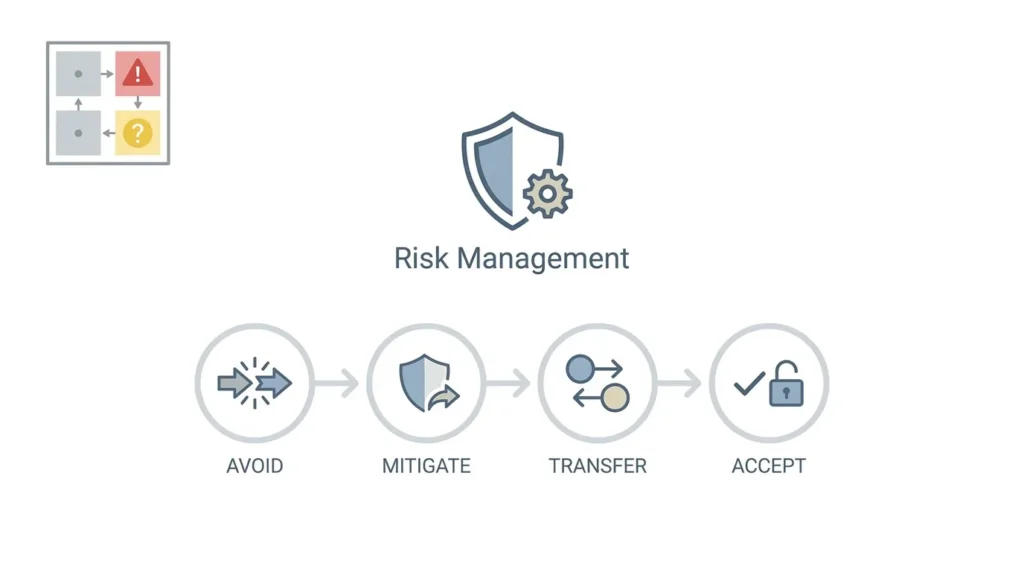
Quick answer: A risk response strategy is your planned action for a risk before it happens. There are ten: five for threats — avoid, transfer, mitigate, accept, escalate — and five for opportunities — exploit, share, enhance, accept, escalate. Choose based on the risk’s probability, its impact, and whether it sits inside your authority.
Table of Contents
Most guides explain what the strategies are. Very few tell you how to pick one. The decision framework below is the part you’ll actually use.
What Is a Risk Response Strategy?
A risk response strategy is the action you decide to take about a risk before it happens.
It is not a reaction. Reacting after the fact is firefighting. A risk response is planned in advance, written down, given an owner, and funded — which is what separates it from good intentions.
Two terms people mix up:
| Term | What it means |
|---|---|
| Risk response strategy | The type of action you’ll take — avoid, transfer, mitigate, and so on |
| Risk response plan | The specific written actions, owner, trigger, and reserves for that risk |
The strategy is the category. The plan is the detail. In practice people use the phrases interchangeably, and that’s usually fine.
Where responses fit in the process. You identify risks and log them in a risk register. You analyse them for probability and impact. You rank them. Then — for the ones that matter — you choose a response strategy and write a plan. The response is step four, not step one.
One thing worth saying early: you do not need a response for every risk. You have a finite budget and finite attention. Responding to all of them is impossible and, more importantly, a waste of both.
What Are the 10 Risk Response Strategies?
The Project Management Institute’s PMBOK Guide defines five strategies for threats and five for opportunities.
Here’s the part that makes them easy to remember: they pair up. Each opportunity strategy is the mirror image of a threat strategy.
| Threat strategy | Opportunity mirror | What both do |
|---|---|---|
| Avoid | Exploit | Remove the uncertainty entirely — in opposite directions |
| Mitigate | Enhance | Change the probability or impact |
| Transfer | Share | Move it to a third party better placed to handle it |
| Accept | Accept | Acknowledge it, take no proactive action |
| Escalate | Escalate | Hand it to someone with the authority to deal with it |
Avoid makes a bad thing impossible. Exploit makes a good thing certain. Mitigate reduces a threat’s probability or impact. Enhance increases an opportunity’s. Once you see the symmetry, you’re learning five ideas rather than ten.
A note on standards. The PMBOK Guide uses avoid, transfer, mitigate, accept, and escalate for threats. ISO 31000:2018 uses slightly different wording for the same logic — its risk treatment options include modifying likelihood, modifying consequence, sharing or transferring, retaining, avoiding, and taking the risk in order to pursue an opportunity. Different vocabulary, same underlying choices. If your organisation follows ISO, translate the words; the decision framework below still applies.
What Are the 5 Threat Response Strategies?
1. Avoid
Avoid means changing the plan so the risk cannot happen at all. You remove the cause rather than manage the consequence.
When to use it: high probability and high impact. If something is likely and would hurt badly, don’t manage it — eliminate it.
How you actually avoid a risk: change part of the project plan, reduce or change scope, extend the schedule, change the approach, or drop the objective that’s in jeopardy.
Example. Your team has never used a particular database technology, and the whole architecture depends on it. Probability of trouble: high. Impact: project-ending. Avoiding it means choosing a technology the team already knows, even though it’s less elegant. The risk doesn’t get smaller — it stops existing.
Risk register row:
| Field | Entry |
|---|---|
| Description | Team has no experience with the proposed database; core architecture depends on it |
| Probability | 8 / 10 |
| Impact | 9 / 10 |
| Rank | 72 |
| Strategy | Avoid |
| Response plan | Switch to PostgreSQL, which three team members have shipped with. Rework architecture doc by 14 Sept. Accept ~10% performance trade-off. |
| Owner | Tech Lead |
The cost of avoiding. Avoidance is rarely free — you usually give up scope, speed, or elegance. That’s the trade, and it’s worth making when the risk is genuinely severe.
2. Transfer
Transfer means making another party responsible for the financial impact of the risk.
When to use it: low probability, high impact. The classic insurance shape — unlikely, but ruinous if it happens.
Common transfer mechanisms: insurance, warranties, performance bonds, fixed-price contracts, and outsourcing to a vendor who carries the liability.
Example. Your project depends on a piece of specialist equipment. The chance of it failing is small. The cost of replacing it mid-project would blow the budget. You buy an extended service contract. The risk still exists — you’ve moved who pays for it.
The catch most guides skip: transfer moves the money, not the consequence. If your vendor fails to deliver, the contract may compensate you financially, but your deadline is still missed and your stakeholders are still unhappy. Transfer protects the budget, not the schedule or the relationship.
Transfer also creates new risks — contract management, vendor dependency, communication overhead. More on that below.
3. Mitigate
Mitigate means reducing the probability of the risk, or reducing its impact, or both. You don’t eliminate it; you make it smaller.
When to use it: high probability, moderate-to-low impact — or when avoiding is too expensive. This is the most commonly used strategy in practice.
Example. Requirements are ambiguous and the deadline is fixed, so there’s a real chance of building the wrong thing. You can’t avoid that. You mitigate: build a prototype in week two and get client feedback before full development. You’ve reduced the probability of a big rework by catching the misunderstanding early.
Risk register row:
| Field | Entry |
|---|---|
| Description | Requirements for the reporting module are ambiguous; risk of building the wrong solution |
| Probability | 7 / 10 |
| Impact | 6 / 10 |
| Rank | 42 |
| Strategy | Mitigate |
| Response plan | Build clickable prototype by 22 Sept. Review with client 25 Sept. Sign-off before development starts. Budget: 3 dev days. |
| Owner | Business Analyst |
Mitigation costs money and time up front, before you know whether you needed it. That’s the psychological hurdle. The prototype costs three days whether or not the requirements were wrong.
4. Accept
Accept means acknowledging the risk and choosing not to act against it in advance. It has two forms, and the difference matters.
Active acceptance means you prepare. You set aside a contingency reserve — time, money, or both — and write a contingency plan, but you only act if the risk actually occurs.
Passive acceptance means you do nothing at all. If it happens, you’ll deal with it then, or absorb the damage.
When to use it: low probability and low impact for passive acceptance. For active acceptance: when the risk is real but responding proactively would cost more than the exposure.
Example of active acceptance. A long project runs through winter, when illness is more common. You can’t avoid that. You add a two-week buffer before the milestone that falls in February. If nobody gets sick, you release the buffer.
One discipline that separates good practice from bad: if the risk doesn’t occur, release the reserve. Otherwise the work expands to fill it, and you learn nothing about whether your estimates were any good.
Example of passive acceptance. A minor third-party library might get a breaking update. Unlikely, and if it happens you’d spend half a day pinning the version. You write it down, assign an owner, and do nothing else.
Accepting is a decision, not a failure to decide. Written down, with an owner, it’s legitimate risk management. Unwritten, it’s just hoping.
5. Escalate
Escalate means handing the risk to someone with the authority to deal with it, because it falls outside your project’s scope or your own authority.
When to use it: whenever the risk is genuinely beyond you — regardless of probability or impact. A regulatory change affecting the whole organisation is not a project risk you can manage locally.
The detail almost everyone gets wrong: once a risk is properly escalated, the project team does not deal with it further. It moves to the programme or portfolio level and someone there owns it. You may keep it in your register for information, but it is no longer yours to manage.
That distinction matters. Escalating and then continuing to worry about it is not escalation — it’s just complaining upward. Escalation is a transfer of ownership, and it needs someone to accept it.
Example. Your project depends on a company-wide licence renewal that’s being negotiated by procurement at board level. You have no influence over it. You escalate to the programme manager, get it accepted, note it in your register as escalated, and stop spending attention on it.
What Are the 5 Opportunity Response Strategies?
Opportunities are risks with a positive effect. Most teams ignore them entirely, which means leaving value on the table.
1. Exploit
Exploit means making sure the opportunity definitely happens. It’s the mirror of avoid — both remove uncertainty, in opposite directions.
When to use it: when the upside is significant and you can realistically guarantee it.
Example. Finishing two weeks early would win you a follow-on contract. You exploit it by assigning your strongest developers to the critical path and removing their other commitments.
2. Share
Share means bringing in a third party better placed to capture the benefit, and splitting the upside.
When to use it: when you can’t realise the opportunity alone.
Example. A large tender needs capabilities you only half have. You partner with a firm that has the rest, bid jointly, and share the contract.
3. Enhance
Enhance means increasing the probability or the size of the opportunity without guaranteeing it. Mirror of mitigate.
When to use it: when you can improve the odds but can’t make it certain.
Example. Equipment prices are expected to drop next quarter, which would free budget. You can’t control prices. You enhance by negotiating a price-protection clause now, so if prices drop you get the lower rate.
Risk register row:
| Field | Entry |
|---|---|
| Description | An existing internal module could replace the custom build for the portfolio feature |
| Probability | 6 / 10 |
| Impact | 8 / 10 (saves ~6 weeks) |
| Rank | 48 |
| Strategy | Enhance |
| Response plan | Run a 3-day proof of concept on integrating the module. Confirm licensing. Present findings to sponsor by 30 Sept. |
| Owner | Solutions Architect |
4. Accept (opportunity)
Accept means you’ll take the benefit if it arrives, but you won’t spend anything to pursue it.
When to use it: small upside, or the cost of pursuing exceeds the likely gain. It is generally the least desirable opportunity strategy — if you can exploit or enhance instead, do.
5. Escalate (opportunity)
Escalate means the opportunity is bigger than your project and belongs at programme, portfolio, or organisational level.
Example. Your team builds a tool that would save every project in the organisation time. That’s not a project opportunity — it’s an organisational one. Escalate it to someone who can act on it properly.
How Do You Choose a Risk Response Strategy?
This is the question most guides don’t answer. Here is a framework built on the guidance in the PMBOK Guide.
The decision matrix
Start with your risk’s probability and impact scores.
| Low impact | High impact | |
|---|---|---|
| High probability | Mitigate — reduce it, cheaply | Avoid — eliminate the cause |
| Low probability | Accept (passive) — log it, move on | Transfer — insure or contract it out |
That matrix comes straight from standard guidance: avoidance suits high-probability, high-impact risks, while transfer suits low-probability, high-impact ones.
And one override that sits outside the matrix entirely: if the risk is beyond your authority or your project’s scope, escalate it — whatever the scores say.
The five-question flowchart
Run any risk through these, in order. Stop at the first yes.
1. Is this outside my authority or my project’s scope? → Escalate. Hand it over properly and stop managing it.
2. Would this risk seriously damage the project, and can I change the plan so it can’t happen? → Avoid. Accept the scope, cost, or schedule trade-off.
3. Is it unlikely but financially severe, and can someone else carry the financial exposure? → Transfer. Insurance, warranty, or contract.
4. Can I cheaply reduce how likely it is, or how much it would hurt? → Mitigate. This will be your answer most of the time.
5. None of the above? → Accept. Actively if it’s worth a reserve, passively if it isn’t. Write it down either way.
Three things the matrix doesn’t capture
Cost of response versus exposure. If mitigating a risk costs £20,000 and the risk’s expected impact is £5,000, mitigating is the wrong answer even if the matrix points there. Always sanity-check the arithmetic.
Risk tolerance. Two organisations facing identical risks will legitimately choose differently. A hospital and a startup have different appetites, and both can be right. Know your organisation’s thresholds before you decide.
Timing. Some responses only work early. Avoiding a technology choice is easy in week one and nearly impossible in month six. Cheap responses have expiry dates.
What Are the Best Practices for Developing a Risk Avoidance Strategy?
Avoidance is the most powerful strategy and the most expensive one, so it needs the most discipline.
1. Confirm it’s genuinely high-probability and high-impact. Avoidance means giving something up. Reserve it for risks that would actually damage the project, not ones that would merely annoy you.
2. Name exactly what you’re giving up. Every avoidance has a price — scope, schedule, budget, or quality. Write it down explicitly. “We avoid the integration risk by dropping the Salesforce sync from phase one” is a real decision. “We’ll avoid integration risks” is a wish.
3. Get the trade-off approved by whoever owns the scope. Avoidance usually changes the project’s shape. That’s a sponsor decision, not a project manager decision made quietly.
4. Act early, while avoidance is still cheap. Technology choices, vendor selection, and architecture are avoidable in the first weeks and effectively fixed later. Front-load your avoidance decisions.
5. Check what the avoidance creates. Removing one risk almost always introduces another. Switching to a familiar technology avoids the learning-curve risk and may create a performance risk. Log the new one.
6. Don’t avoid by delegation. Handing the risky work to a vendor is transfer, not avoidance. The risk still exists; someone else is exposed to it. Calling it avoidance hides real exposure in your register.
7. Update the plan, not just the register. An avoidance decision that doesn’t change the scope statement, the schedule, or the budget hasn’t actually happened yet.
8. Record why. In six months someone will ask why you dropped that feature. The register row is your answer.
What Are Secondary and Residual Risks?
Every response creates consequences. Two terms cover them, and both belong in your register.
| Term | Definition | Example |
|---|---|---|
| Secondary risk | A new risk created by implementing your response | You transfer development to a vendor. New risk: vendor communication delays |
| Residual risk | What’s left over after the response is implemented | You mitigate a security risk with penetration testing. Residual: undiscovered vulnerabilities |
Why this matters practically: a response plan that creates a bigger secondary risk than the one it solved is a bad plan, and you only see that if you look. After choosing every response, ask two questions — what does this create? and what’s left?
Residual risks need to be communicated, not just logged. Stakeholders should know what remains after you’ve done everything you plan to do. Discovering residual risk at the moment it materialises is how trust gets lost.
How Do You Write a Risk Response Plan?
The strategy is one word. The plan is what makes it happen.
A complete risk response plan has seven fields:
| Field | What goes in it |
|---|---|
| Risk description | The condition and its effect, in one sentence |
| Strategy | One of the ten |
| Actions | Specific, dated, assignable steps |
| Owner | One named person, not a team |
| Trigger | The observable signal that the risk is materialising |
| Reserve | Time and money set aside, if any |
| Residual + secondary risks | What remains, and what this creates |
The trigger is the field most often left blank and the one that makes the plan work. A contingency plan with no trigger never activates, because nobody knows when to start. “If the vendor misses two consecutive weekly milestones” is a trigger. “If things start going wrong” is not.
Template:
RISK:        [Condition] may cause [effect] to [objective]
PROBABILITY: [1-10]    IMPACT: [1-10]    RANK: [P × I]
STRATEGY:    [Avoid / Transfer / Mitigate / Accept / Escalate /
              Exploit / Share / Enhance]
ACTIONS:     1. [Action] — [Owner] — [Date]
             2. [Action] — [Owner] — [Date]
OWNER:       [Named person + contact]
TRIGGER:     [Observable condition that activates this plan]
RESERVE:     [Time] / [Budget]
SECONDARY:   [New risk this response creates]
RESIDUAL:    [What remains after the response]
STATUS:      [Planned / Active / Triggered / Closed]
One owner per risk, always. Shared ownership means nobody watches it. One person can own several risks — just check they can’t all trigger at once, or you’ve built a single point of failure.
Risk Response Strategies in Project Management: Agile and Hybrid Delivery
The ten strategies are the same regardless of methodology. How you apply them changes a lot.
What’s different in adaptive delivery:
| Predictive (waterfall) | Adaptive (agile) |
|---|---|
| Risk register reviewed monthly | Risks surfaced continuously, reviewed each iteration |
| Response plans written up front | Responses decided at the last responsible moment |
| Contingency reserve as a schedule buffer | Buffer as unallocated sprint capacity |
| Risk owner assigned formally | Often the team collectively, with one named lead |
| Escalation via governance | Escalation via impediment removal |
Three things agile does natively that are risk responses under another name:
Spikes are mitigation. A timeboxed investigation to reduce technical uncertainty before committing is exactly the mitigate strategy. Call it that in your register and it becomes visible to stakeholders.
Backlog prioritisation is avoidance. Choosing not to build the risky feature this quarter avoids its risk. That’s a real risk response and it usually goes unrecorded.
Short iterations are structural mitigation. They reduce the impact of being wrong by shortening how long you can be wrong for. It’s mitigation designed into the process rather than decided per risk.
Where agile teams get caught out: iterative delivery handles emergent risk well — the unknowns you discover as you go. It handles structural risk badly — regulatory deadlines, vendor contracts, fixed budgets. Those need explicit, up-front responses regardless of methodology.
Practical advice for hybrid teams: keep a lightweight register for structural risks reviewed monthly, and handle emergent risk in your normal iteration ceremonies. Don’t force sprint-level uncertainty into a formal register — it’ll be stale within a week and nobody will read it.
What Are the Most Effective Risk Response Strategies Used by Top Project Management Software?
Worth reframing the question honestly: software doesn’t have strategies. It has features that make the ten strategies easier to run.
What the better tools actually give you:
| Capability | Which strategy it supports |
|---|---|
| Risk register with probability × impact scoring | All — it’s the input to the decision matrix |
| Automatic risk ranking and heat maps | Prioritising which risks get a response at all |
| Response plan fields linked to tasks | Mitigate and avoid, by turning plans into real work |
| Owner assignment and reminders | All — ownership is what makes plans execute |
| Trigger alerts and threshold monitoring | Active acceptance, by firing contingency plans on time |
| Contingency reserve tracking | Active acceptance, by showing whether reserves are intact |
| Escalation workflows | Escalate, with a real handover rather than an email |
| Audit trail and version history | Governance, and answering “why did we decide that?” |
The feature that matters most and is most often missing: linking a response plan to actual scheduled tasks. A mitigation plan that lives only in a risk register is a document. The same plan represented as three tasks with owners and dates in the project schedule is work that gets done. If your tool can’t do that, your responses will quietly not happen.
What no software does for you: decide the strategy. Judge whether the response costs more than the exposure. Know your organisation’s risk appetite. Those are judgement calls, and a heat map won’t make them.
How Can I Implement Risk Response Strategies with Cloud-Based Risk Management Solutions?
Cloud tools help most with the parts of risk management that fail for human reasons — visibility, ownership, and follow-through.
A practical implementation sequence:
1. Standardise the register fields first, before choosing a tool. Use the seven fields above. Tools change; your data structure shouldn’t have to.
2. Set your scoring scale and write it down. A 1–10 probability scale means nothing unless everyone agrees what a 7 is. Define the anchors.
3. Set the threshold that triggers a response. For example: any risk ranked above 40 gets a written plan; below that, log and monitor. Without a threshold, teams either respond to everything or nothing.
4. Link every response to real tasks. As above — this is the step that determines whether anything actually happens.
5. Assign single named owners with automated reminders. A monthly nudge to each risk owner does more than any dashboard.
6. Configure trigger alerts. Where a trigger is measurable — a date, a budget threshold, a milestone slip — automate the alert.
7. Set a review cadence and protect it. Monthly for predictive projects, per-iteration for adaptive. A register nobody reviews decays within weeks.
8. Build the roll-up path. Project risks that cross a materiality threshold should be visible at portfolio level. That’s how escalation works in practice rather than in theory.
Three cautions:
Don’t confuse a dashboard with a decision. A well-populated heat map can create a comfortable feeling that risk is being managed when no responses have been executed. Track response completion, not risk count.
Watch what you upload. Risk registers often contain commercially sensitive information — vendor problems, staffing issues, contract exposure. Check your tool’s data handling before putting it there, particularly for regulated work.
Beware alert fatigue. If everything triggers a notification, people stop reading notifications. Alert on triggers and thresholds only.
7 Mistakes That Undermine Risk Responses
1. Writing a response for every risk. You have a finite budget. Set a threshold and respond to what crosses it.
2. Leaving the trigger blank. A contingency plan without a trigger never activates.
3. Assigning risks to teams. One named person, or nobody watches it.
4. Calling transfer “avoidance.” The risk still exists. Mislabelling hides real exposure.
5. Not releasing unused reserves. Work expands to fill them, and you learn nothing about your estimating.
6. Escalating and then still managing it. Escalation transfers ownership. If you’re still worrying about it, it wasn’t accepted.
7. Ignoring opportunities entirely. Five of the ten strategies exist for upside. Most registers contain zero opportunities, which means value is being left unclaimed by default.
Risk Response Checklist
- [ ] Every risk above your threshold has a chosen strategy
- [ ] The strategy matches the probability–impact quadrant, or you’ve documented why not
- [ ] Anything beyond your authority has been escalated and accepted by someone
- [ ] Each response plan has dated, assignable actions
- [ ] Each risk has one named owner with contact details
- [ ] Each contingency plan has an observable trigger
- [ ] Reserves are quantified in time and money
- [ ] Secondary risks from each response are logged
- [ ] Residual risks are logged and communicated to stakeholders
- [ ] Response actions exist as real tasks in the schedule, not just in the register
- [ ] Cost of each response is less than the exposure it addresses
- [ ] Opportunities are in the register, not only threats
- [ ] Review cadence set and diarised
- [ ] Project plan, budget, and schedule updated to reflect responses
How Writegenic AI Fits In
Risk response plans are documents — and documents are the bottleneck. The strategy takes five minutes to choose. Writing it up properly, for thirty risks, in a form stakeholders will actually read, is what gets skipped.
Writegenic AI is an AI writing platform with 300+ templates and support for 120+ languages, including a set built for project documentation:
- AI for Project Management — drafting project documents from structured inputs
- Project management tools — templates for the surrounding artefacts
- Requirements management plan generator — for the document risk responses often reference
- AI Prompt Generator — build one reusable prompt encoding your register fields and scoring scale so every plan comes out consistent
Where the line sits. A writing tool can turn your decisions into a clear, complete, consistently formatted plan, and it can draft thirty of them in the time it takes to write three. It cannot decide whether to avoid or mitigate, judge your organisation’s risk appetite, or know that your vendor has been unreliable before. Those are your calls, and they’re the part that matters.
Draft with the tool. Keep the judgement.
Start with Writegenic AI free.
Frequently Asked Questions
What are the risk response strategies?
There are ten. Five for threats: avoid, transfer, mitigate, accept, and escalate. Five for opportunities: exploit, share, enhance, accept, and escalate. They pair up — exploit mirrors avoid, enhance mirrors mitigate, and share mirrors transfer.
What is a risk response strategy in project management?
It’s the planned action you’ll take about a risk before it occurs — chosen in advance, written down, given an owner, and funded. It differs from reacting to a problem after it happens, which is issue management rather than risk management.
How do you choose a risk response strategy?
Use probability and impact. High probability plus high impact points to avoid; low probability plus high impact points to transfer; high probability plus low impact points to mitigate; low and low points to accept. Override all of that with escalate if the risk sits outside your authority.
What is the difference between a risk response strategy and a risk response plan?
The strategy is the category of action — one word, like “mitigate.” The plan is the detail: specific actions, dates, owner, trigger, and reserves. In everyday use the terms are often interchangeable.
What is the difference between avoid and mitigate?
Avoid removes the cause so the risk cannot occur. Mitigate reduces how likely it is or how much it would hurt, but the risk still exists. Avoidance usually costs you scope or schedule; mitigation usually costs you effort.
What is the difference between transfer and avoid?
Transfer moves the financial impact to another party — insurance, a warranty, a contract. The risk still exists and can still hurt your schedule. Avoidance means the risk cannot happen at all.
What are secondary and residual risks?
A secondary risk is a new risk created by implementing your response — outsourcing to avoid a skills gap creates vendor dependency. A residual risk is what remains after the response — penetration testing reduces security risk but doesn’t eliminate undiscovered vulnerabilities.
What is active versus passive acceptance?
Active acceptance means setting aside a contingency reserve and writing a plan you’ll use only if the risk occurs. Passive acceptance means doing nothing at all and dealing with it if it happens. Both are legitimate; both should be written down.
When should you escalate a risk?
When it falls outside your project’s scope or beyond your authority to address — a regulatory change, an organisation-wide contract, a decision above your level. Once escalated and accepted, the project team does not manage it further, though it may stay in the register for information.
Do agile projects use risk response strategies?
Yes — the same ten. Agile teams often apply them without naming them: a spike is mitigation, deprioritising a risky feature is avoidance, and short iterations are structural mitigation. Naming them makes them visible to stakeholders.
Should you write a response for every risk?
No. You have finite budget and attention. Set a ranking threshold — for example, any risk scoring above 40 gets a written plan — and log the rest for monitoring.
What are good risk strategies for a small project?
The same ten, applied more lightly. A one-page register, a threshold for what gets a plan, one owner per risk, and a monthly review will cover most small projects. Formality should scale with consequence, not with enthusiasm.
Related reading: AI for Project Management · Requirements Management Plan · Project Management Tools · What Is an AI Prompt Generator?