

How to Write a Real Estate Listing Description + Examples
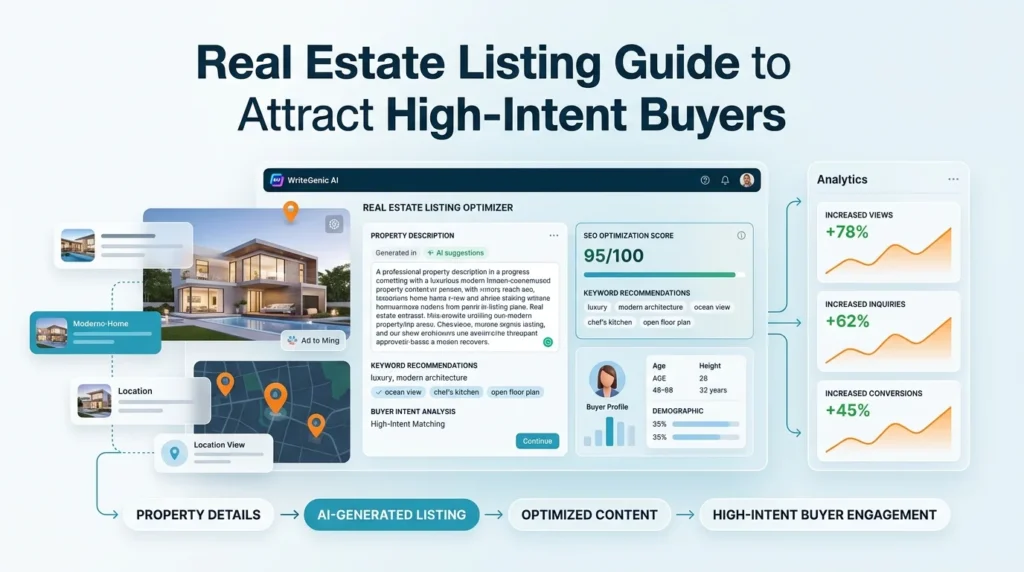
Quick answer: Open with one specific, vivid sentence about the property’s best feature. Walk the buyer through the home in the order they would actually see it. Use exact numbers instead of adjectives. Close with one clear call to action. Keep it to 150–250 words, and describe the house — never the kind of person who should live in it.
That last rule is not a style tip. It is the law, and we will come back to it.
Write a real estate listing well is a repeatable process, not a talent. Work through the steps in order and you will get the same result every time.
Table of Contents
What Is a Real Estate Listing Description?
A real estate listing description is the written part of a property listing. On the MLS it is usually called the “public remarks” field. It is the paragraph a buyer reads under the photos on Zillow, Redfin, or Realtor.com.
Its job is not to sell the house. Its job is to get one showing booked.
That distinction changes everything about how you write it. You are not closing a deal in 200 words. You are giving one specific person a reason to stop scrolling and tap “Schedule a Tour.”
Here is why the writing still matters even though photos get more attention. According to the National Association of Realtors, 43% of buyers start their home search by looking at properties online, and every single buyer uses the internet somewhere in the process. When NAR asked buyers what website content they valued most, the answers were photos (41%), detailed property information (39%), and floor plans (31%).
Detailed property information is your listing description. It is the second most valuable thing on the page, and most agents write it in ninety seconds.
What Are the Key Components of an Effective Real Estate Listing Description?
Every listing description that works has five parts, in this order.
1. The hook (one sentence). The single most specific, most interesting true thing about this property. Not “beautiful home.” Something a buyer could not guess from the photos.
2. The walkthrough (3–5 sentences). Move through the house the way a buyer would physically move through it. Front door, main living space, kitchen, bedrooms, outside. This order matters because it is how people build a mental map.
3. The proof (2–3 sentences). Exact numbers, dates, and upgrades. “New roof in 2023.” “1,860 square feet.” “32-by-45-foot fenced yard.” Numbers do something adjectives cannot: they build trust.
4. The location (1–2 sentences). What is nearby, described factually. Distances in miles or minutes. Named places, not judgments about the area.
5. The call to action (one sentence). Tell them exactly what to do next. “Showings begin Saturday — schedule through the lockbox.”
That’s the whole structure. If your draft is missing one of the five, it is not finished.
The 5-Part Formula, Filled In
Here is the formula applied to one real property, so you can see the parts snap together:
Hook: The kitchen window frames forty feet of mature oak, and it is the reason the current owners bought this house.
Walkthrough: A covered porch opens into a light-filled living room with original 1985 hardwood. The kitchen runs along the back of the house with a full view of the yard, and connects directly to a dining space that seats eight. Three bedrooms sit down a short hall, with the primary bedroom at the quiet end.
Proof: 1,860 square feet, three bedrooms, two full baths. New roof in 2023, HVAC replaced in 2021, and stainless appliances installed last spring.
Location: Six minutes to the Main Street shops and 1.2 miles to the county park trailhead.
CTA: Showings begin Saturday at 10am. Schedule through the lockbox or call to arrange a private tour.
That is 148 words and roughly 880 characters. It fits inside almost every MLS limit in the country, which brings us to the next part.
How Long Should a Real Estate Listing Description Be?
Aim for 150 to 250 words, which is roughly 900 to 1,500 characters with spaces.
But your real limit is set by your MLS board, and those limits vary a lot. Here are published limits from several boards:
| MLS board | Public remarks limit |
|---|---|
| Bright MLS (Mid-Atlantic) | 1,000 characters |
| MRED (Chicago area) | 1,000 characters |
| BeachesMLS (Florida) | 800 characters |
| REIN (Hampton Roads, VA) | 1,000 characters |
| HRAR (Harrisonburg, VA) | 750 characters |
Reported limits for other boards range from 500 up to 2,500 characters, and published figures sometimes disagree with each other. Do not trust a list on a blog, including this one. Open your own MLS, click into the public remarks field, and find the real number before you write. It takes thirty seconds and it is the only figure that matters.
One more thing about length: characters are not words. A 500-character limit is only about 75 to 100 words. A 1,000-character limit is about 150 to 175 words. Count characters, not words, when you are close to the edge.
Your First 250 Characters Are Doing All the Work
This is the single most useful thing in this guide, and almost nobody knows it.
Zillow shows only about the first 250 characters of your description on a search results card. After that, the reader gets a “Read more” button they probably will not tap.
So a buyer scrolling through forty listings sees roughly your first two sentences. That’s it.
This means your opening is not a warm-up. It is ad copy. Treat those first 250 characters as the entire listing, and treat everything after as the reward for people who clicked.
Weak opening (wasted):
Welcome to this beautiful home in a great neighborhood. This lovely property has many wonderful features that you are sure to appreciate.
That is 138 characters and says nothing. A buyer learns zero facts.
Strong opening (works):
The kitchen window frames forty feet of mature oak. Inside: 1,860 square feet, three bedrooms, new roof in 2023, and a 45-foot fenced yard.
Same character budget. One of these gets a showing.
Words That Add Value
Some words genuinely help. Zillow’s analysis of listing language found terms like “impeccable,” “luxurious,” and “landscaped” were associated with stronger sale prices. Words that describe craft, condition, and specific materials tend to work because they are checkable.
Use words like these when they are true:
| Category | Words that work |
|---|---|
| Condition | impeccable, updated, renovated, restored, well-maintained |
| Materials | granite, quartz, hardwood, slate, copper, cedar |
| Light and space | south-facing, light-filled, vaulted, open-concept |
| Outside | landscaped, fenced, irrigated, covered, screened |
| Specifics | 2023, 1,860 sq ft, 40-foot, three-car, double-height |
Notice the pattern. Every good word is either a material, a measurement, or a verifiable condition. That is the whole trick.
Words to Avoid
Zillow’s research on 24,000 homes also identified words that hurt. Terms like “fixer,” “TLC,” and “cosmetic” signal to buyers that a lot of work is needed, which invites lower offers. Only use them if the home genuinely needs work and is priced for it.
Also cut these, for different reasons:
| Avoid | Why |
|---|---|
| cozy | Everyone knows it means small |
| charming | Says nothing checkable |
| must see | Every listing says this |
| motivated seller | Tells buyers to offer less |
| stunning, gorgeous, amazing | Pure opinion, zero information |
| Exclamation marks everywhere | If everything is exciting, nothing is |
| ALL CAPS | Reads as shouting, and some MLS boards ban it |
A good test: could a competing agent write the same sentence about a completely different house? If yes, delete it.
Fair Housing: The Words That Can Actually Get You in Trouble
This section is the one most listing guides skip, and skipping it is how good agents get into real trouble.
This is educational information, not legal advice. Protected classes vary by state and city. Check your own market’s rules and talk to your broker or an attorney about anything you are unsure of.
Here is the core rule, and it is simpler than people think:
Describe the property. Never describe the person who should live there.
The federal Fair Housing Act protects race, color, religion, sex, national origin, disability, and familial status. Many states and cities add more, such as sexual orientation, gender identity, marital status, age, source of income, and military status.
The part that surprises people is that this is not a discrimination test — it is a signal test. You do not have to reject anyone. You do not even have to intend anything. Under Section 3604(c), copy that merely indicates a preference based on a protected class is the problem. “Perfect for empty nesters” does not turn anyone away. It just signals who the listing is written for, and that signal is the violation.
And this catches nice people writing nice copy. Here are common offenders with compliant swaps:
| Risky phrase | Why it’s a problem | Write this instead |
|---|---|---|
| Perfect for a growing family | Signals familial status preference | Four bedrooms and a flexible bonus room |
| Ideal for young professionals | Signals age and familial status | Nine-minute drive to the business district |
| Safe neighborhood | Can read as coded steering | Corner lot on a cul-de-sac with street lighting |
| Walking distance to St. Mary’s | Signals religious preference | 0.4 miles from Oak Street |
| Bachelor pad | Signals sex and marital status | One-bedroom with an open floor plan |
| No children | Direct familial status violation | (Remove entirely) |
| Great for retirees | Signals age | Single-level layout with no interior steps |
| Master bedroom | Not a legal violation, but many boards now prefer otherwise | Primary bedroom |
A note on age-restricted language: “55+” and “adults only” are lawful only if the property genuinely qualifies for the Housing for Older Persons exemption and meets its occupancy and verification requirements. Do not borrow that wording because it sounds upmarket. Confirm the property actually qualifies first.
One more thing agents miss. Section 3604(c) covers advertising, and advertising is not just the MLS. The same standard applies to your flyers, yard-sign riders, email blasts, and social captions. A phrase you would not put in the MLS is not safer on Instagram — it is arguably riskier, because social captions are exactly where agents relax and start describing the buyer to drive engagement. The person who publishes is the person on the hook.
Most MLS systems will not catch this for you. They check for formatting problems like missing photos, not legal compliance. The review is yours.
Who Are High-Intent Buyers in 2026?
Here is where most listing advice is quietly out of date, and where you can get a real edge.
“High-intent buyer” means someone who can actually close, not just someone who clicks. And that person looks very different than they did five years ago. From NAR’s most recent buyer data:
- 73% of recent buyers had no child under 18 at home — the highest share ever recorded.
- First-time buyers fell to 21–24% of the market, the lowest since NAR started tracking in 1981.
- Repeat buyers are now about 79% of all buyers. Around 30% paid all cash, and their median down payment hit 23% — the highest since 2003.
- The median buyer age reached a record high, and the typical repeat buyer is in their early sixties.
- Neighborhood quality and proximity to friends and family overtook job location as the top priority.
Now put that next to the copy most agents still write.
“Perfect for a growing family, close to top-rated schools” is doing two bad things at the same time. It creates Fair Housing exposure. And it aims at the smallest, least cash-rich slice of the current buyer pool.
The buyers most able to close today are older, mostly without children at home, often paying cash, and choosing on neighborhood quality and single-level living rather than school zones and commute times.
So the compliant copy and the high-intent copy turn out to be the same copy. Describing the property in concrete, factual terms is both the legally safe move and the commercially smart one. That is a genuinely lucky alignment, and you should use it.
What high-intent buyers respond to:
- Exact numbers they can filter and verify
- Recent upgrades with dates, because they signal fewer surprises
- Single-level layouts, low-maintenance yards, and storage
- Real distances to named places
- Honest disclosure of what needs work, because cash buyers price it in rather than walking away
How to Write a Compelling Real Estate Listing Description (Step by Step)
Do it in this order. It takes about fifteen minutes once you have done it a few times.
Step 1 — Walk the property and write down twenty facts. Not adjectives. Facts. Square footage, year built, what was replaced and when, ceiling heights, yard dimensions, which way the windows face.
Step 2 — Ask the seller one question. “What made you buy this house?” Their answer is usually your hook, and it is the one thing no competing listing has.
Step 3 — Pick your single best fact. The one that is both true and surprising. That becomes sentence one.
Step 4 — Write the walkthrough in physical order. Front door to back yard. Do not jump around.
Step 5 — Add the numbers. Drop in the upgrades and measurements from Step 1.
Step 6 — Add location as distances. Minutes and miles to named places.
Step 7 — Write one call to action. One. Not three.
Step 8 — Cut 20%. Every listing gets better when you delete a fifth of it. Adjectives go first.
Step 9 — Check your first 250 characters. Read only those. Would you book a showing? If not, rewrite the opening.
Step 10 — Run the Fair Housing check. Read every sentence and ask: am I describing the house, or the person? Fix anything in the second category.
Step 11 — Read it out loud. This catches awkward phrasing and typos better than reading silently. A single typo makes buyers doubt your attention to detail on everything else.
8 Real Estate Listing Description Examples
Each example shows weak copy, then a rewrite, with the character count so you can see it fits.
1. Starter condo
Before:
Cute cozy condo, great starter home for young couple or single professional! Won’t last!!
After:
Top-floor one-bedroom with south-facing windows and no shared walls on the bedroom side. 720 square feet, in-unit laundry, and a dedicated parking space. Building replaced the roof and elevator in 2024, so the HOA reserve study is clean. Assigned storage locker in the basement. Four blocks to the Green Line. Open house Sunday, 1–3pm.
412 characters. Removed “young couple” and “single professional,” which signal age and marital status. Added the HOA detail cash buyers actually ask about.
2. Suburban three-bedroom
Before:
Perfect family home in a safe, family-friendly neighborhood with great schools! Lots of room for the kids to play.
After:
The back deck faces west, and the current owners eat dinner out there most of the summer. Inside: 1,740 square feet, three bedrooms, two baths, and an open kitchen-to-living layout on one level. New roof in 2023, HVAC in 2021. The fenced yard is 40 by 60 feet with an irrigation system and mature maples. Cul-de-sac lot with street lighting. 1.1 miles to the Oak Street shops.
468 characters. This is the swap that matters most. Every risky phrase in the original is gone, and the replacement is more informative.
3. Luxury property
Before:
Absolutely STUNNING luxury estate! Truly must be seen to be believed! An entertainer’s dream!
After:
Commissioned in 2019 and finished with quarter-sawn white oak throughout. 5,200 square feet across two levels, with 11-foot ceilings on the main floor and a 30-foot wall of south-facing glass in the great room. Chef’s kitchen with a 48-inch range, marble waterfall island, and a full butler’s pantry. Primary suite includes a private terrace and a 200-square-foot dressing room. Landscaped 1.4-acre lot with an irrigated garden and a heated 40-foot pool. Private tours by appointment.
576 characters. At this price point, specificity is the luxury signal. Vague superlatives read as cheap.
4. Fixer-upper
Before:
Handyman special! Needs TLC but tons of potential! Cosmetic fixer, bring your vision!
After:
Single-owner 1962 ranch on a 0.3-acre corner lot, priced for renovation. Structure and foundation were inspected in June and both reports are available on request. The roof was replaced in 2018. Kitchen and both bathrooms are original and will need full updates. Original oak floors are under the carpet throughout and appear to be in good condition. 1,420 square feet with an unfinished basement of the same footprint. Cash and renovation-loan offers welcome.
532 characters. “TLC,” “fixer,” and “handyman special” all invite lowball offers. Honest, specific disclosure attracts serious renovation buyers instead of bargain hunters.
5. New construction
Before:
Brand new construction! Everything is new! Move in ready! Best value in the area!
After:
Completed July 2026, never occupied. 2,100 square feet with 9-foot ceilings, engineered white oak floors, and a covered rear porch. All-new systems under builder warranty through 2036, including a 16-SEER heat pump and a tankless water heater. Kitchen has quartz counters, a vented range hood, and soft-close cabinetry. Single-level layout with no interior steps and a zero-step entry from the garage. Sod, irrigation, and fencing included. Showings daily.
530 characters. The zero-step entry and single-level detail speak directly to the largest buyer group in the current market.
6. Rural property with acreage
Before:
Peaceful country living! Get away from it all! Perfect for a family that wants space!
After:
12.4 acres with roughly 400 feet of frontage on Pine Creek. The 1,980-square-foot farmhouse was rewired in 2020 and re-roofed in 2022. Well and septic were both inspected this spring; reports available. Fenced pasture on the east four acres with a 36-by-48-foot pole barn and two water hydrants. Wood stove plus a propane furnace. 14 miles to Route 9, 22 minutes to the Millerton grocery. Fiber internet is connected and active.
490 characters. Rural buyers care about well, septic, and internet more than atmosphere. Answer that first.
7. Single-level home for downsizers
Before:
Great retirement home! Ideal for seniors or empty nesters looking to downsize!
After:
Single-level 1,510-square-foot layout with zero interior steps and a zero-step entry from the attached garage. Both bathrooms have 36-inch doorways and the primary bath has a curbless shower. Laundry is on the main floor next to the primary bedroom. Low-maintenance landscaping with drip irrigation on a timer. New roof 2024. HOA covers lawn care and snow removal at $180 per month. 0.6 miles to the Franklin Street medical campus.
486 characters. The original signals age preference and is a Fair Housing risk. The rewrite describes the exact same accessibility features factually, which reaches the same buyer legally.
8. Investment property
Before:
Great investment opportunity! Cash cow! Perfect for investors! Tenants in place!
After:
Legal two-family, both units currently leased through May 2027. Unit A is 2 bed / 1 bath at $1,650 per month; Unit B is 1 bed / 1 bath at $1,200. Separate gas and electric meters, shared water. Roof replaced 2021, both furnaces 2019. Annual taxes $4,880; insurance $2,140. Rent roll, leases, and two years of expenses available on request. Off-street parking for three. Sold subject to existing tenancies.
476 characters. Investors buy numbers. Give them the numbers and skip the excitement.
Tips for Writing Real Estate Listings That Sell Quickly
Speed comes from removing friction, not from adding hype.
Be accurate on day one. Every correction you post later resets buyer trust and can reset your listing’s position on portals. Get the data fields right before you publish.
Front-load the answer to the buyer’s biggest question. For a fixer it is “how bad is it.” For rural it is “is there internet.” For a condo it is “what does the HOA cover.” Answer it in the first three sentences and you stop losing people who would have kept scrolling.
Name the flaw yourself. Buyers find every flaw at the showing anyway. Naming it in the listing filters out the wrong buyers before they waste your Saturday, and it makes the right buyers trust everything else you wrote.
Use exact dimensions instead of “large.” Exact numbers appear in search filters and reassure buyers that the property matches what they need.
Write the CTA like an instruction. “Schedule through the lockbox” beats “contact us today for more information.”
Match tone to price point. Upbeat and practical for a starter condo. Restrained and precise for a luxury estate. Mismatched tone reads as inexperience.
Pair the description with real photos. Buyers rank photos as the most valuable content on a listing page. Poorly lit or grainy images will sink even excellent copy. Natural light, curtains open.
Update the description if the price drops. A price change with stale copy tells buyers nothing changed but the number. Add the new fact that justifies a second look.
Listing Description vs. Real Estate Business Description
These two get mixed up, and they are completely different jobs.
A listing description sells one property to buyers. It lives in the MLS public remarks field, it is 150–250 words, and it is governed by Fair Housing advertising rules.
A real estate business description sells you. It lives on your website’s About page, your Google Business Profile, your brokerage bio, and your social profiles. It is usually 50–150 words and it answers three questions: who you serve, what area you know, and why someone should call you instead of the other twelve agents in town.
A quick business description that works:
[Name] has closed 140 transactions in the [Area] market since 2018, with a focus on single-level and downsizer properties in [Town] and [Town]. Licensed in [State], [designation] certified. Known for pricing accuracy and full pre-listing inspections. Call or text [number] for a no-obligation valuation.
Same rule applies here as everywhere: specific numbers beat adjectives.
6 Mistakes That Kill a Listing Description
1. Repeating the data fields. Bed count, bath count, and square footage already appear elsewhere on the listing page. Do not spend your character budget on them unless a number is genuinely remarkable.
2. Putting contact info in the public remarks. Many MLS boards prohibit it outright and will flag your listing. It belongs in agent remarks.
3. Describing the buyer. Covered above. It is the highest-consequence mistake in this entire guide.
4. All-caps and exclamation marks. Some boards ban caps. Buyers dislike both.
5. Writing 400 words for a 750-character field. Your best lines get cut off mid-sentence by the system.
6. Never reading the first 250 characters alone. Most agents have never once checked what their listing looks like on a search results card.
Pre-Publish Checklist
- [ ] Opening 250 characters read well on their own
- [ ] Every claim is factually accurate and verifiable
- [ ] Under your board’s real character limit (you checked the field, not a blog)
- [ ] Five parts present: hook, walkthrough, proof, location, CTA
- [ ] At least four exact numbers or dates
- [ ] Zero phrases describing the buyer instead of the property
- [ ] No “perfect for,” “ideal for,” “safe,” or “great for”
- [ ] Age-restricted language only if the property legally qualifies
- [ ] No contact info in public remarks
- [ ] One call to action, not several
- [ ] Read aloud once, typos fixed
- [ ] Seller has reviewed and approved it
- [ ] Same copy checked for compliance before it goes on social or a flyer
Can You Use AI to Write Listing Descriptions?
Yes, and most agents already do. But be clear about what AI is good at and what it is not.
AI is very good at the blank page. Give it your twenty facts and it will produce a structured draft in seconds, in the tone you asked for. It is also good at compressing a 400-word draft down to a 900-character MLS field without losing the important parts, which is the tedious part of the job.
What AI cannot do is take responsibility. An AI draft can produce Fair Housing risk just as easily as a rushed human draft, because “perfect for a growing family” is an extremely common phrase in the text these models learned from. You are the one who publishes, so you are the one who is liable. Every AI draft needs a human compliance read before it goes live. Treat the model as a fast first-draft writer, not as a compliance tool.
Draft Listing Descriptions Faster with Writegenic AI
You now have the framework. The slow part is doing it fifteen times a month, in the right tone each time, inside a character limit.
That is where Writegenic AI Real Estate Listing helps.
Writegenic is an AI writing platform with 300+ tailored templates for business and marketing content. You feed in the property facts, say what kind of buyer and tone you want, and get a structured draft you can edit down.
What matters for this particular job:
- Tone control. A starter condo and a luxury estate need completely different voices. Generate both and choose.
- The Magical AI Editor. Tighten a long draft into an MLS-safe length. Cutting is where most listing copy is won.
- 120+ languages. Useful if your market has buyers who would rather read in Spanish, Mandarin, or Portuguese.
- Team collaboration. Brokerages can share one approved structure so every agent’s listings hold the same standard.
- SEO-optimized generation for the property pages, neighborhood guides, and blog posts your listings link out to.
To be straight with you: Writegenic drafts copy, it does not certify legal compliance. Use the Fair Housing checklist in this guide on every draft, whoever or whatever wrote it.
You can start with Writegenic AI free and have your next listing drafted in about two minutes.
Frequently Asked Questions About Write a Real Estate Listing
How do you write a real estate listing description that sells?
Open with one specific, surprising fact about the property. Walk the buyer through the home in physical order. Back it up with exact numbers and upgrade dates. Add real distances to named places. Close with one clear instruction. Keep it to 150–250 words and describe the property, never the buyer.
What are the key components of an effective real estate listing description?
Five: a hook, a walkthrough in physical order, proof in the form of numbers and dates, location described as distances, and a single call to action.
How long should a real estate listing description be?
150 to 250 words, or about 900 to 1,500 characters. Your hard ceiling is your MLS board’s public remarks limit, which commonly falls between 750 and 1,500 characters. Check your own field before writing.
What words should you avoid in a real estate listing?
Avoid words that describe the buyer rather than the home — “perfect for families,” “ideal for young professionals,” “great for retirees,” “bachelor pad,” “safe neighborhood.” Also avoid “fixer,” “TLC,” and “cosmetic” unless the home genuinely needs work and is priced for it, since they invite lower offers.
What words add value to a listing description?
Words describing materials, measurements, and verifiable condition. Zillow’s analysis found terms like “impeccable,” “luxurious,” and “landscaped” were associated with stronger sale prices. Anything checkable beats anything subjective.
Why does the first sentence matter so much?
Because Zillow shows only about the first 250 characters on a search results card. A buyer scrolling forty listings sees roughly your first two sentences and nothing else unless they tap through.
Can I mention nearby schools in a listing?
Naming a school district factually is generally acceptable, but judgments like “top-rated schools” combined with family-focused language can signal a familial status preference. Safer approach: give the district name and distance, and let buyers draw conclusions. Check your state and local rules.
Should the seller approve the listing description?
Yes. Send it for approval while the listing is still in pre-listing status. A change requested after publication has to be corrected everywhere the listing has syndicated.
Is it legal to write “55+” or “adults only”?
Only if the property genuinely qualifies for the Housing for Older Persons exemption and meets its occupancy and verification requirements. Otherwise it is a familial status violation. Confirm eligibility before using that wording.
Related reading: AI Copywriter · AI Content Templates · Article Wizard
